CompTIA Network+ vs. CCNA:
Which Is Better?
Compare exam difficulty, cost, salary potential, and career paths to find the right IT networking certification for your goals in 2026.
Every IT career starts with a decision. For people drawn to networking, that decision almost always narrows down to two certifications: CompTIA Network+ and Cisco’s CCNA. Both are entry points into one of the most in-demand areas in technology, both appear on job postings, and both are respected by hiring managers. Yet they are built on entirely different philosophies, lead to different career trajectories, and reward different kinds of learners.
The honest answer to “which is better” is that neither is universally superior. The better question is which one is better for you, given where you are starting and where you want to go. This guide breaks down every dimension of the comparison so you can make that call with confidence.
What Is CompTIA Network+?

CompTIA Network+ is a vendor-neutral certification ideal for IT beginners building a broad foundation in networking.
Network+ is an IT certification offered by CompTIA. When you earn the Network+ certificate, you demonstrate baseline IT skills that can be applied to any network or vendor. That word “any” is the key to understanding why this certification exists and who it serves.
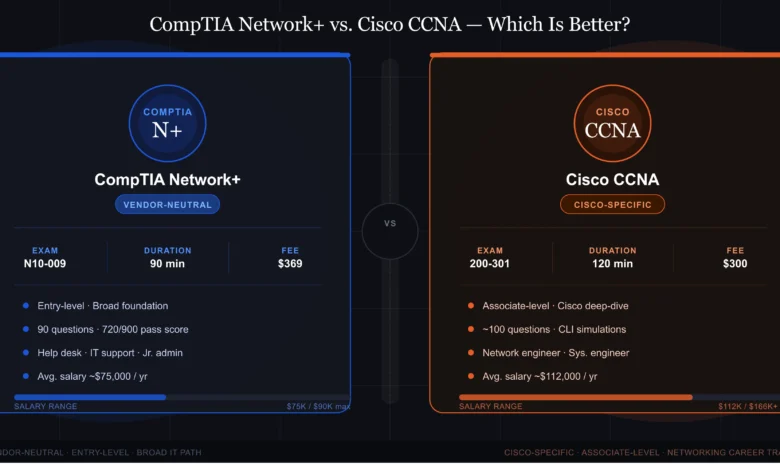
CompTIA Network+ (exam N10-009) is an entry-level, vendor-neutral certification designed to prove you understand the foundational principles of IT networking without tying your knowledge to a specific brand of hardware. It covers both baseline technical skills — network architecture, security, and troubleshooting — and relevant business skills such as change management, disaster recovery, and incident management.
That business skills component is something many people overlook. In addition to technical skills, the Network+ certificate covers relevant business skills that can apply to IT positions, helping diversify your skill set and allowing you to grow into roles with additional responsibilities.
What Is Cisco CCNA?

CCNA is Cisco’s associate-level certification and the gateway to a high-paying career in network engineering.
CCNA stands for Cisco Certified Network Associate. Unlike Network+, this certification focuses specifically on Cisco hardware and software. Cisco is one of the biggest names in networking equipment, so their certification carries a lot of weight in the industry.
CCNA is a Cisco-specific certification that goes deeper into networking concepts, with a particular focus on Cisco hardware and software. It is more advanced and geared towards professionals looking to specialize in Cisco networks, which are widely used in enterprise settings.
The CCNA 200-301 covers subnetting, routing protocols, VLANs, STP, OSPF, wireless, and now automation and programmability — a forward-looking addition that prepares candidates for how modern networks are actually managed. Cisco has certified over one million people as CCNA professionals, and Cisco continues to be the leading networking brand across the globe.
Exam Structure and Format: A Side-by-Side Breakdown
Understanding what you are actually walking into on exam day is essential for planning your study time and setting realistic expectations.
CompTIA Network+ Exam (N10-009)
The exam is a 90-minute test with a maximum of 90 questions. Candidates must achieve at least 720 out of 900 to pass. It includes multiple-choice and performance-based questions covering five domains: networking fundamentals, network implementations, network operations, network security, and network troubleshooting. On Network+, if you forget a specific detail, you can often rely on the process of elimination — the exam rewards conceptual understanding rather than exact syntax recall.
Cisco CCNA Exam (200-301)
The CCNA is a 120-minute test with approximately 100 questions, including multiple-choice, drag-and-drop, simlets, and testlets. The passing score is not officially published but is estimated around 80% correct answers.
| Feature | CompTIA Network+ | Cisco CCNA |
|---|---|---|
| Exam Code | N10-009 | 200-301 |
| Time Limit | 90 minutes | 120 minutes |
| Questions | Up to 90 | ~100 |
| Passing Score | 720 / 900 | ~80% (unpublished) |
| Exam Fee | $369 | $300 |
| Question Types | MCQ + PBQ | MCQ + simulations + drag-and-drop |
| Vendor Focus | Vendor-neutral | Cisco-specific |
| Validity | 3 years | 3 years |
Difficulty Level: How Hard Are These Exams?
Cisco CCNA is significantly harder than CompTIA Network+. While Network+ is described as being easy to start, CCNA requires deep, highly technical knowledge. Network+ is broader but shallower; CCNA is narrower but goes much deeper on Cisco-specific topics.
For preparation timelines, CompTIA recommends 9–12 months of hands-on networking experience before Network+, but in practice most people pass with 3–4 months of focused study from scratch. The class length says it all: most institutions cover Network+ in about 45 hours, whereas CCNA is usually covered in three distinct 45-hour courses — a college instructor takes three times as long to finish CCNA content.
Prerequisites: What Do You Need Before Starting?
Neither certification has formal hard gates — you can purchase a voucher and take either exam today. However, CompTIA strongly recommends 9 to 12 months of general IT experience before attempting Network+, and Cisco recommends at least 1 year of direct networking experience before attempting CCNA.
For CCNA, Cisco recommends familiarity with IP addressing, routing and switching concepts, and network troubleshooting. Many students prepare through Cisco Networking Academy courses or via help desk or junior networking roles. Those entering CCNA without prior exposure often spend more time studying or require supplemental labs.
Cost Comparison: Exam Fees and Total Investment
On the surface the exam fees are close, but the total cost of preparation tells a different story. The CompTIA Network+ exam costs $369 for the voucher. The Cisco CCNA exam is priced at $300 — so the CCNA exam itself is actually cheaper. However, the total investment is often higher for CCNA due to specialized study materials, lab environments, and much longer preparation time.
| Cost Factor | Network+ | CCNA |
|---|---|---|
| Exam voucher | $369 | $300 |
| Study books / materials | $30–$150 | $50–$300 |
| Lab tools | Minimal | Packet Tracer / GNS3 |
| Prep courses | $100–$500 | $200–$800 |
| Typical total investment | ~$500–$1,000 | ~$600–$1,400 |
Salary Potential: What Can You Earn?
This is where the comparison shifts most decisively in one direction. Network+ holders average around $75,000 per year. CCNA holders average around $112,000 — and that is just the starting gap. The $37,000 difference per year at mid-level reflects the type and complexity of roles each cert qualifies you for.
The long-term ceiling is even more significant. From CCNA you can move into CCNP (specialist level) and eventually CCIE (expert level) — the most respected networking certification on the planet — taking you to $166,000 or more per year. Network+ does not have that same vertical path: CompTIA’s progression goes toward Security+ or CySA+, which are security certifications, not networking.
| Career Stage | Network+ Salary | CCNA Salary |
|---|---|---|
| Entry-level | ~$55,000 | ~$75,000 |
| Mid-level | ~$75,000 | ~$112,000 |
| Senior / Specialist | ~$90,000 | $130,000–$166,000+ |
Career Paths and Job Opportunities
The certifications do not just pay differently — they lead to fundamentally different types of roles. CompTIA Network+ can lead to entry-level IT positions such as help desk technician, IT support specialist, or junior network administrator. CCNA aligns with more specialized roles like network engineer, network administrator, or systems engineer — particularly in companies using Cisco solutions.
When you search for network engineer roles on LinkedIn or Indeed, CCNA shows up in requirements roughly three times more often than Network+. For anything with “network engineer,” “infrastructure,” or “Cisco” in the job title, CCNA is expected and sometimes required.
🔷 Network+ Jobs
- Help Desk Technician
- IT Support Specialist
- Junior Network Administrator
- Network Support Technician
- Field Engineer
- IT Infrastructure Technician
🔶 CCNA Jobs
- Network Engineer
- Network Administrator
- Systems Engineer
- Infrastructure Specialist
- VoIP Engineer
- Network Security Specialist
Industry Recognition and Market Weight
In Ethernet switches, Cisco holds a 47 percent market share and 33% of the combined SP and enterprise router industry. Cisco also holds 29.8% of the enterprise network infrastructure market overall, and the CCNA holds significantly more weight with hiring managers for dedicated networking roles.
That market dominance means CCNA’s vendor-specific focus is less of a limitation than it might initially seem. When the vendor in question powers nearly half of all enterprise network switches, knowing their system deeply is useful across a wide range of employers worldwide. Network+ counters with breadth and portability: if a company switches from Cisco to Microsoft or Juniper, your foundational Network+ knowledge remains entirely relevant.
Certification Validity and Renewal
Both Network+ and CCNA certifications have a validity period of three years, after which recertification is required to maintain an active status. The renewal paths differ, however.
CompTIA Network+ is renewed through CompTIA’s Continuing Education (CE) program. CCNA renewal requires retaking the exam or earning higher-level Cisco certifications such as CCNP. CCNA holders can also obtain CE credits through the Cisco Learning Network, which offers webinars, video training, and downloadable learning guides.
Which Certification Should You Get First?
Aspirants planning to sit for both certifications should first consider Network+, as the test is more general and involves less preparation. Professionals who obtain Network+ successfully can continue toward the CCNA and earn that certificate within 60–90 days, assuming they have access to simulation software or lab content and equipment.
If you already hold an active Cisco CCNA, there is zero professional benefit to going back and taking CompTIA Network+. Because the CCNA is significantly harder, more advanced, and highly respected, hiring managers already assume you know the foundational concepts covered in Network+. Earning Network+ after CCNA is like going back to get your high school diploma after you have already earned a bachelor’s degree.
✅ Choose Network+ If You…
- Are brand new to IT with no prior networking experience
- Want vendor-neutral, transferable skills across multiple platforms
- Plan to pivot toward cybersecurity or cloud computing later
- Want a shorter, more accessible study path
- Are targeting help desk or junior admin roles
🚀 Choose CCNA If You…
- Already have some IT or networking exposure
- Want to specialize as a network engineer
- Are willing to invest more time and money in preparation
- Want a cert that leads to CCNP and eventually CCIE
- Are targeting Cisco-heavy enterprise environments
Frequently Asked Questions
Disclaimer: All salary figures are sourced from current market data as of 2025–2026. Exam fees and formats are subject to change — always verify current details on the official CompTIA and Cisco websites before registering. This article is for informational purposes only and does not constitute career advice.







2 Comments