📅 Updated: May 2026 • ⏱ 16 min read • ✅ Fact-checked & sourced • ✍ ClassesPlace.com Editorial Team
Every AWS career starts with one question: which certification do you take first?
For most people, the answer narrows to two exams — the AWS Certified Cloud Practitioner (CLF-C02) and the AWS Certified Solutions Architect – Associate (SAA-C03). Both appear on job postings. Both are respected. Both promise a real career boost. But they are built on completely different philosophies, demand different levels of effort, and lead to very different outcomes.
The honest answer to “which is better” is that neither is universally superior. The better question is: which one is right for you, given where you are starting and where you want to go?
This guide compares every dimension that matters — exam format, cost, difficulty, salary impact, prerequisites, and career trajectory — so you can make that call with confidence.
Quick Answer (TL;DR)
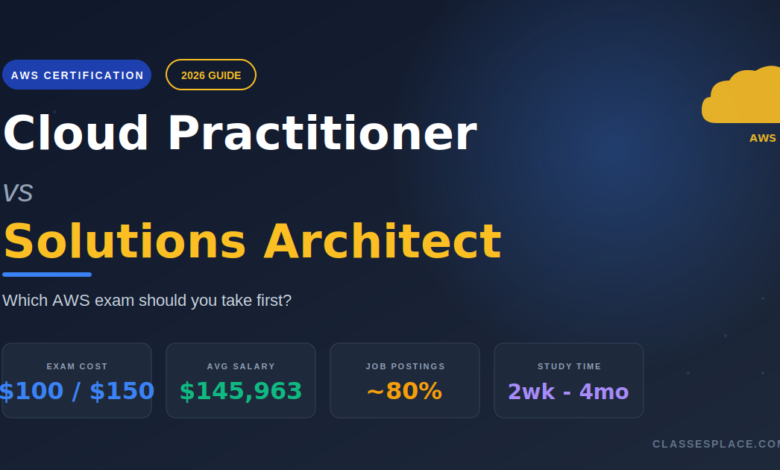
- The AWS Cloud Practitioner (CLF-C02) costs $100, has 65 questions in 90 minutes, and is foundational — ideal for beginners, non-technical roles, and career-changers.
- The AWS Solutions Architect Associate (SAA-C03) costs $150, has 65 questions in 130 minutes, and is technical — built for people who will design and build on AWS.
- If you’re new to cloud: take Cloud Practitioner first.
- If you have IT experience and want a real salary jump: skip straight to Solutions Architect Associate. Job postings reward it — the SAA appears in around 80% of cloud job listings, while the foundational cert is rarely requested by name.
What Is the AWS Cloud Practitioner Certification?
The AWS Certified Cloud Practitioner (CLF-C02) is the entry-level certification in the AWS path. Think of it as the 101 course for the entire AWS ecosystem. Its job is to give you a high-level understanding of what AWS is, why companies use it, and how its core services fit together.
It is not a technical exam. There are no labs, no command line, no architecture diagrams to design. The questions test whether you can explain AWS to a customer, a finance team, or a manager — not whether you can build on it.
Who the Cloud Practitioner Is Designed For
AWS positions this exam for candidates “independent of a specific job role,” but in practice it serves four audiences best:
- Total beginners with no IT or cloud background who want a structured way to learn AWS.
- Non-technical professionals in sales, marketing, finance, or project management who work alongside engineering teams.
- Career-changers testing whether cloud is a fit before committing months to deeper certifications.
- Managers and decision-makers who need cloud literacy to evaluate vendor proposals and budgets.
What the CLF-C02 Exam Covers
The exam blueprint splits into four content domains, with the heaviest weight on services and security:
- Cloud Concepts — 24% (cloud economics, AWS Well-Architected Framework, value of the cloud)
- Security and Compliance — 30% (the AWS shared responsibility model, IAM basics, compliance)
- Cloud Technology and Services — 34% (core compute, storage, network, and database services)
- Billing, Pricing, and Support — 12% (pricing models, support plans, cost-management tools)
Notice that two domains — security and services — make up almost two-thirds of the scored content. Most candidates who fail underestimate the security domain because it sounds easier than it is.
What Is the AWS Solutions Architect Associate Certification?
If the Cloud Practitioner is a 101 course, the AWS Certified Solutions Architect – Associate (SAA-C03) is a 300-level technical lab. It is one of the most recognized credentials in the entire IT industry — and one of the most commercially valuable certifications you can earn at the associate level.
This exam stops asking “what is AWS?” and starts asking “how do you build on AWS?” Candidates are tested on designing systems that are scalable, fault-tolerant, secure, and cost-optimized. The questions are scenario-based: a business has a problem, here are constraints, choose the best architecture.
Who the SAA-C03 Is Designed For
AWS recommends this exam for candidates with at least one year of hands-on experience designing solutions on AWS. In reality, many candidates pass with 1–3 years of general IT experience and 3–6 months of focused AWS study. It suits:
- Solutions architects, network architects, and systems administrators moving into cloud roles.
- Developers who want to design and deploy production AWS workloads, not just write code that runs on them.
- DevOps and SRE engineers who need to make architectural decisions about reliability and cost.
- Anyone who already passed the Cloud Practitioner and wants the cert that hiring managers actually look for.
What the SAA-C03 Exam Covers
The four domains and weightings are:
- Design Secure Architectures — 30% (IAM, VPC security, encryption, secure access patterns)
- Design Resilient Architectures — 26% (high availability, multi-AZ, decoupling, disaster recovery)
- Design High-Performing Architectures — 24% (auto scaling, caching, performance tuning, storage selection)
- Design Cost-Optimized Architectures — 20% (pricing models, right-sizing, cost-effective storage classes)
Every domain rewards practical judgment. You will not pass the SAA by memorizing service names — you have to know when to choose Aurora over RDS, when S3 Intelligent-Tiering beats S3 Standard-IA, and when a Network Load Balancer makes more sense than an Application Load Balancer.
AWS Cloud Practitioner vs Solutions Architect Associate: Head-to-Head
Here is the side-by-side comparison most candidates are looking for. All numbers are based on the official AWS exam guides as of 2026.
| Feature | Cloud Practitioner (CLF-C02) | Solutions Architect Associate (SAA-C03) |
|---|---|---|
| Level | Foundational | Associate |
| Exam cost | $100 USD | $150 USD |
| Number of questions | 65 (50 scored + 15 unscored) | 65 (50 scored + 15 unscored) |
| Time limit | 90 minutes | 130 minutes |
| Passing score | 700 / 1000 | 720 / 1000 |
| Recommended experience | Up to 6 months of AWS exposure | 1+ year designing AWS solutions |
| Typical study time | 2–6 weeks | 2–4 months |
| Hands-on labs required? | No | Strongly recommended |
| Validity | 3 years | 3 years |
| Languages | 10 (incl. English, Japanese, Spanish, Chinese) | 10 (incl. English, Japanese, Spanish, Chinese) |
One detail people miss: AWS no longer enforces hard prerequisites for any of its exams. You can buy a voucher and take the SAA-C03 today, even with zero AWS background. Whether you should is a different question — covered below.
Difficulty: How Hard Is Each Exam Really?
The Cloud Practitioner is widely considered the easiest AWS certification. Most well-prepared candidates pass on their first attempt with 2–6 weeks of focused study. The pass rate, based on aggregated data from AWS training partners, hovers around 70%.
The Solutions Architect Associate is a meaningfully harder exam. Pass rates published by training providers typically land in the 60–72% range, depending on the cohort. The difficulty jump comes from three places:
Scenario complexity. CLF-C02 questions usually have one obviously-correct answer. SAA-C03 questions often present three plausible architectures and ask which is best given specific cost, performance, or compliance constraints. You can know every service and still fail by misreading the constraint.
Service depth. Cloud Practitioner expects you to know what S3 is. SAA expects you to know S3 Standard, S3 Standard-IA, S3 One Zone-IA, S3 Glacier Instant Retrieval, S3 Glacier Flexible Retrieval, S3 Glacier Deep Archive, S3 Intelligent-Tiering — and which to pick for a given workload.
Multi-service reasoning. Many SAA questions require chaining services together — a VPC with private subnets, a NAT Gateway, an Application Load Balancer, an Auto Scaling Group, an RDS Multi-AZ database, and S3 cross-region replication. You have to hold the whole picture in your head.
If you are new to AWS, expect the SAA to take 4–5 times the study effort of the Cloud Practitioner.
Salary Impact: Which Certification Pays More?
This is where the gap becomes obvious.
The Cloud Practitioner certification, on its own, is rarely listed as a job requirement. Hiring managers see it as a signal of cloud literacy — useful, but not a credential employers pay a premium for. People who hold only the CLF-C02 typically land in cloud-adjacent roles (sales, support, project coordination) where the salary impact is real but modest.
The Solutions Architect Associate is in a different league.
According to ZipRecruiter data from March 2026, the average annual salary for an AWS Solutions Architect Associate in the United States is around $145,963, with the typical range falling between $126,000 and $166,000. Top earners (90th percentile) make $183,000 or more.
Glassdoor data, drawn from a slightly different sample, places the average AWS Solutions Architect total compensation closer to $176,000, with the 75th percentile reaching $216,408. Senior and principal-level architects regularly clear $250,000 in total compensation at FAANG companies.
Research from Jefferson Frank, a specialist AWS recruiter, found that 73% of AWS-certified professionals received a raise after certification, with an average increase of around 27%. The Solutions Architect Associate appears in roughly 80% of cloud job postings — making it the single most-requested AWS credential by hiring managers.
If your goal is salary, the SAA is the cert that moves the needle.
Career Paths Each Certification Opens
The two certs lead to genuinely different career trajectories.
Cloud Practitioner Career Outcomes
With a Cloud Practitioner certification, candidates typically move into:
- Cloud sales and account management — AWS partners and resellers actively hire CCP-certified salespeople.
- Project management for cloud initiatives — PM roles where understanding AWS terminology and pricing is enough.
- Junior cloud support — help desk and tier-1 cloud support roles, especially with AWS partner companies.
- Stepping-stone study — the most common outcome is using CLF-C02 as the launch pad for SAA-C03 within 6–12 months.
Solutions Architect Associate Career Outcomes
The SAA opens doors to genuinely technical roles with strong salary trajectories:
- Cloud engineer / cloud solutions architect — the direct fit, with average US salaries above $145K.
- DevOps engineer — especially with infrastructure-as-code experience added (Terraform, CloudFormation).
- Site reliability engineer (SRE) — AWS architecture knowledge is a strong differentiator.
- Backend engineer specializing in cloud-native applications — serverless, microservices, container orchestration.
- Pre-sales solutions engineer at AWS, Microsoft, Google Cloud, or partners — technical sales roles that pay $200K+ in total compensation.
Which AWS Certification Should You Take First?
Three honest paths, depending on your background.
Path 1: The Standard Path (CLF-C02 → SAA-C03)
Take Cloud Practitioner first if you have no IT background, you find cloud computing genuinely new, or you want a confidence-builder before tackling a harder exam. The CLF-C02 builds the vocabulary and conceptual base that makes SAA-C03 study far less overwhelming. Total cost: $100 + $75 (50% discount voucher applied to SAA after first cert) = $175 for both. This is the right path for the majority of complete beginners.
Path 2: The Direct Path (Skip to SAA-C03)
Skip Cloud Practitioner entirely if you are an experienced developer, sysadmin, network engineer, or DevOps practitioner. You already understand the underlying concepts — what a load balancer does, why redundancy matters, how DNS works. Spending a month on CLF-C02 means spending a month learning what you already know. The 50% retake discount also disappears: paying $150 for SAA directly is cheaper than $100 + $75 for both.
Path 3: The Specialist Path (CLF-C02 → AI Practitioner / Data / Security)
If your career is heading into AI, data analytics, or security — not infrastructure design — take Cloud Practitioner first to ground yourself, then branch into AWS Certified AI Practitioner, Data Engineer Associate, or Security Specialty rather than Solutions Architect. Solutions Architect is broad. The specialist certifications go deeper into one domain and pay similar salaries when paired with the right experience.
Best Study Resources for Each Exam
Both exams reward a mix of structured courses, hands-on practice, and quality practice questions. Resources that consistently produce passes:
For both exams:
- AWS Skill Builder — the official AWS learning platform, with free CLF-C02 and SAA-C03 learning paths and one free practice question set per exam.
- Stephane Maarek’s “Ultimate AWS Certified” courses on Udemy — widely regarded as the gold standard prep videos for both exams. Look for sale prices ($15–$25).
- Tutorials Dojo practice tests — consistently the closest match to actual exam difficulty. The reviews-mode explanations alone are worth the price.
For SAA-C03 specifically:
- Adrian Cantrill’s “AWS Certified Solutions Architect – Associate” course — deeper and more architecture-focused than the Udemy options, with strong hands-on labs.
- An AWS Free Tier account — do not skip the hands-on. The exam tests architecture decisions, and architecture decisions only stick if you have actually deployed VPCs, set up auto-scaling, and broken something with an IAM policy.
Common Mistakes to Avoid
A few patterns kill more candidates than the exams themselves.
Buying exam dumps. Dumps violate the AWS Certification Agreement and lead to certification revocation if AWS detects unusual answer patterns. They also do not work the way candidates hope — AWS regularly rotates question banks, and the SAA-C03 in particular tests reasoning, not memorization. Build understanding, not memory.
Skipping the security domain on Cloud Practitioner. Security and Compliance is 30% of the CLF-C02 — the largest single domain. Many candidates assume “foundational” means “easy” and underprepare. The shared responsibility model alone produces 4–6 questions per exam.
Studying SAA-C03 with no AWS console time. If you have never created a VPC, attached an Internet Gateway, or set a security-group rule by hand, scenario questions will read like a foreign language. AWS Free Tier covers everything you need.
Underestimating exam fatigue on the SAA. 130 minutes for 65 scenario-based questions is tighter than it sounds. Many candidates run out of time on the last 10 questions. Practice with full-length timed mock exams, not just question-by-question review.
Frequently Asked Questions
Is the AWS Cloud Practitioner a prerequisite for the Solutions Architect Associate?
No. AWS removed all hard prerequisites from its certification program. You can take the SAA-C03 directly without ever taking the CLF-C02. The Cloud Practitioner is recommended as a foundation for beginners, but it is not required.
How long does it take to study for the AWS Cloud Practitioner?
Most candidates pass with 2–6 weeks of focused study, around 30–60 total study hours. Career-changers with no IT background should plan closer to 6–8 weeks; experienced IT professionals often pass in 1–2 weeks.
How long does it take to study for the AWS Solutions Architect Associate?
Plan for 2–4 months of consistent study (6–10 hours per week), or roughly 80–150 total study hours. This includes time spent in the AWS console building real architectures, not just watching videos.
Can I take both AWS exams at the same time?
Yes, but most candidates space them by 2–6 weeks. Pass the Cloud Practitioner first, claim the 50% discount voucher AWS provides for your next exam, then schedule the SAA-C03 once your study is complete.
Do AWS certifications expire?
Both certifications are valid for three years. You can recertify by retaking the current version of the exam, or by earning a higher-level certification — passing the SAA-C03 automatically renews any active CLF-C02, and passing the Solutions Architect Professional automatically renews an active SAA.
Is the AWS Solutions Architect Associate worth it in 2026?
For most cloud-bound IT professionals, yes. The SAA-C03 is one of the highest-ROI certifications in technology, with average US salaries above $145,000 and a presence on roughly 80% of cloud job postings. The exam costs $150 and 80–150 study hours, and typically produces a measurable salary increase within 6–12 months of earning it.
Final Verdict: Which One Wins?
Neither certification “wins” in absolute terms. They serve different goals.
The AWS Cloud Practitioner wins if you are starting from zero, working in a non-technical role, or testing whether cloud is a fit before committing months to harder exams. It is the cheapest, fastest credential in the AWS ecosystem and the best on-ramp for beginners.
The AWS Solutions Architect Associate wins if your goal is a real salary jump, a technical cloud role, or a credential that hiring managers actually look for. It is more expensive, harder, and slower to earn — and the only one of the two that consistently shows up as a job requirement.
If you have to choose only one, take the SAA. If you have time and want a structured path, take the CLF first and then the SAA. There is no wrong answer — but there is a wrong reason, which is taking the easier exam to avoid the harder one.
The cloud market is not getting smaller. The certifications that prove you can build on AWS will pay you back many times over the price of the exam.
Related guides on ClassesPlace:
About the Author
This guide was researched and written by the ClassesPlace.com Editorial Team and reviewed against the official AWS Certification Exam Guides for CLF-C02 and SAA-C03. Salary data is sourced from ZipRecruiter, Glassdoor, and Salary.com (March–April 2026). We update this article whenever AWS revises its certification roadmap.






One Comment