How to use ChatGPT for homework (the smart student’s guide for 2026)
In this guide: Whether you are in high school or university, learn exactly how to use ChatGPT for homework — step by step — in a way that is effective, ethical, and safe from AI detection tools.
Table of Contents
- Why students are turning to ChatGPT in 2026
- What is ChatGPT and how does it work?
- Step-by-step: Use ChatGPT for different subjects
- Best ChatGPT prompts for students (copy & paste)
- Is using ChatGPT for homework cheating?
- Tips to avoid AI detection
- Frequently asked questions
ChatGPT has completely transformed the way students approach homework. Millions of learners now use it to brainstorm ideas, understand difficult concepts, summarize long texts, and get instant feedback on their writing — all in seconds.
But there is a right way and a wrong way to use it. Done correctly, ChatGPT becomes your smartest study partner. Done wrong, it can get you into serious academic trouble. This guide shows you exactly how to get the most out of it, responsibly.
1. Why students are turning to ChatGPT in 2026
The numbers tell a clear story. ChatGPT use among students has exploded over the past two years, and it shows no signs of slowing down.
According to Pew Research Center, the share of US teens using ChatGPT for schoolwork doubled from 13% in 2023 to 26% in 2024. Meanwhile, a College Board survey found that 69% of high school students used ChatGPT for homework help in 2025. The trend is unmistakable — AI has become a standard study tool.
2. What is ChatGPT and how does it work?
ChatGPT is an AI chatbot developed by OpenAI. You type a question or instruction — called a “prompt” — and it produces a detailed, human-like response in seconds. It can explain concepts, write outlines, solve equations, summarize books, check grammar, and much more.
The free version at chat.openai.com is more than enough for most student tasks. A paid plan (ChatGPT Plus at $20/month) gives access to more advanced models and file uploads — useful for university students handling research papers.
The better your prompt, the better ChatGPT’s answer. Always specify your subject, grade level, and the format you need — for example: “Explain for a Grade 10 student in 3 bullet points.”
3. Step-by-step: Use ChatGPT for different subjects
Essay writing
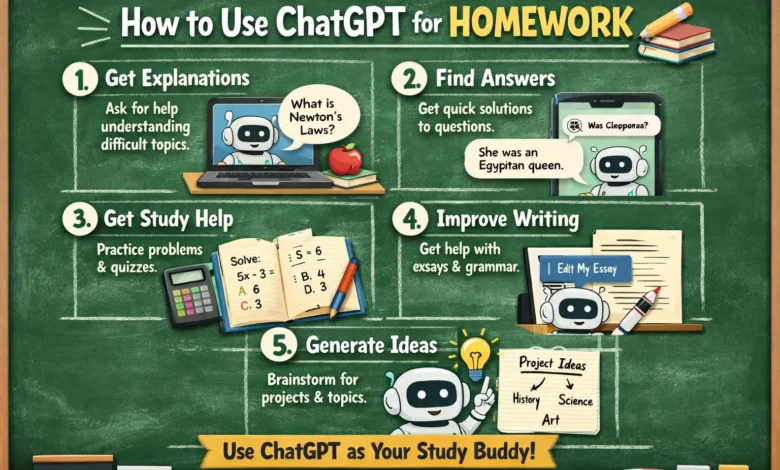
Do not ask ChatGPT to write your entire essay — use it to generate an outline first, then write each section yourself. This keeps your voice intact and avoids plagiarism flags.
Math homework
Ask ChatGPT to explain the steps, not just give you the answer. Understanding the method is what you need to pass your exam.
Science subjects
Use ChatGPT to break down complex topics into plain language. Then write your notes in your own words — this doubles as active recall practice.
Summarizing long readings
Paste a long textbook passage into ChatGPT and ask for a structured summary. Perfect for chapters you are short on time for.
Grammar and proofreading
Rather than just auto-correcting, ask ChatGPT to explain every mistake. You will learn faster this way.
Exam preparation
Ask ChatGPT to generate practice questions based on your topic. Then answer them and ask it to grade your responses.
4. Best ChatGPT prompts for students (copy & paste)
These are ready-to-use prompts — just swap the brackets for your topic:
5. Is using ChatGPT for homework cheating?
This is the most common question — and the answer depends entirely on how you use it.
Using ChatGPT to understand a concept, get feedback on your draft, generate ideas, or build a study guide is widely considered a learning tool — similar to using Google or asking a tutor.
Copying ChatGPT’s output word-for-word and submitting it as your own is academic dishonesty in most schools and universities. Always check your institution’s AI policy first.
Research backs this up. According to Pew Research Center, 54% of teens consider using ChatGPT to research new topics acceptable, while only 18% say it is acceptable to have it write essays. The consensus is: use AI as a thinking aid, not a replacement for your own work.
6. Tips to avoid AI detection
If your school uses AI detection tools such as Turnitin or GPTZero, here is how to use ChatGPT responsibly and stay safe:
- Always rewrite in your own words. Never paste ChatGPT’s output directly into your submission.
- Use it as a starting point, not the final answer. Let it give you a skeleton, then build on it yourself.
- Add your own examples and opinions. AI cannot replicate your personal experiences or classroom knowledge.
- Mix your sources. Do not rely solely on ChatGPT — use textbooks, articles, and your class notes too.
- Ask ChatGPT to explain, not write. “Explain how X works” is safer and more educational than “Write me an essay about X.”
- Read your school’s AI policy. Many schools now have official guidelines on permitted AI use — know them before you begin.
How to Use ChatGPT for Homework and Studies (Scribbr Guide)
7. Frequently asked questions
Final thoughts
ChatGPT is one of the most powerful study tools available to students today — but like any tool, it is only as useful as the person using it. The students who get the most value from it are those who use it to learn faster, not to avoid learning altogether.
Start with the prompt templates in this guide, experiment with what works for your subjects, and always bring your own thinking to the final output. That is how you get better grades and actually build skills that last.