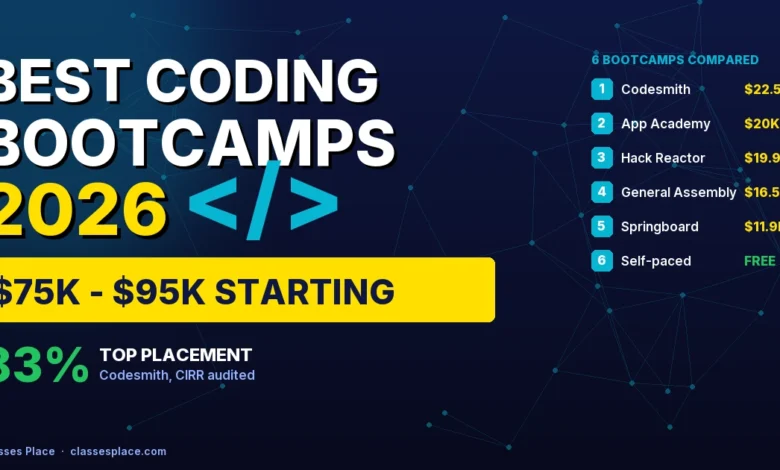
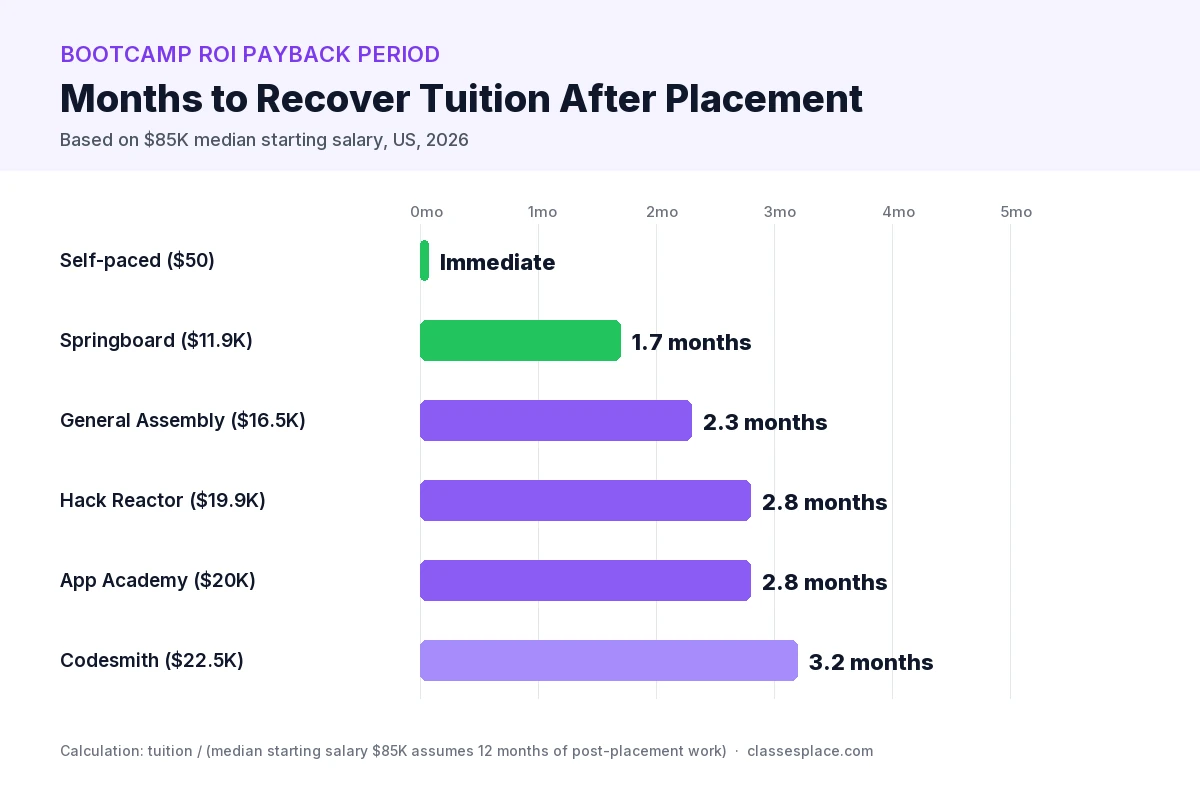
The average reputable coding bootcamp in 2026 costs $12,000–$22,000 and reports job-placement rates of 70–84% within 12 months for graduates who finish. Average starting salary for placed graduates lands around $78,000–$92,000 in the US — meaning even a $20,000 tuition pays back within 4–5 months of placement. But the bootcamp landscape has shifted hard since 2024: several big-name programs closed, ISA financing became scarcer, and the strongest survivors now have to compete with free alternatives like The Odin Project. This guide ranks six coding bootcamps that are still operating in 2026 by cost, real-world placement, and which type of career-changer each one fits.
TL;DR
- Codesmith ($22,000) consistently reports the highest audited placement rate among major 2026 coding bootcamps, with CIRR-audited outcomes above 83%.
- Springboard Software Engineering Career Track ($12,000) is the best part-time option with a tuition-refund job guarantee for working career-changers.
- App Academy and Hack Reactor remain the most established full-time options, with strong alumni networks despite tuition near $20,000.
- The cheapest credible path is free — The Odin Project + freeCodeCamp + a public GitHub portfolio. Lower placement rate but zero financial risk.
- The bootcamp market has consolidated since 2024. Lambda School (BloomTech), Holberton, and several others have closed or pivoted. Verify a program is currently operating before paying tuition.
How we ranked these coding bootcamps
Coding bootcamp evaluation is harder than cybersecurity bootcamps because the market includes more closed-down programs and more questionable placement claims. We weighed each program against five publicly verifiable signals:
- CIRR audited outcomes — Council on Integrity in Results Reporting publishes third-party-audited placement data for participating bootcamps.
- Currently operating — the bootcamp must still be enrolling students as of 2026 (Lambda School / BloomTech is excluded for this reason).
- Tuition refund or guarantee structure — programs with real money behind their placement claims.
- Curriculum currency — covers modern stacks (React, TypeScript, cloud deployment, AI-tool integration) rather than outdated frameworks.
- Verifiable alumni outcomes — visible alumni on LinkedIn at named tech employers, not just promotional case studies.
Tuition and duration figures are from each provider’s 2025–2026 published materials. Outcome numbers reflect each bootcamp’s most recent reported data, audited where indicated.
The 6 best coding bootcamps for career changers in 2026
1. Codesmith — CS Pulse Software Engineering Immersive
- Cost: $22,535
- Duration: 13 weeks full-time (60+ hrs/week)
- Format: Online live cohort
- Placement (CIRR audited): ~83% within 180 days
- Best for: Career-changers targeting senior or mid-level engineering roles
Codesmith is widely regarded as the most rigorous coding bootcamp still operating in 2026. The curriculum goes deeper than most competitors — students build open-source production code as their capstone, which routinely lands graduates as mid-level (not just junior) software engineers. Codesmith publishes CIRR-audited outcomes annually, making their placement rates the most credible on this list. The admissions bar is meaningfully harder than other bootcamps — expect a technical interview as part of the application.
2. App Academy — Full-Stack Software Engineering
- Cost: $20,000 (or ISA — income share agreement)
- Duration: 16 weeks full-time / 24 weeks part-time
- Format: Online cohort
- Placement (self-reported): ~74% within 6 months
- Best for: Career-changers who want a deferred-payment option via ISA
App Academy pioneered the income-share agreement model in coding bootcamps. You can defer tuition and pay a percentage of your post-graduation salary instead of upfront cost — useful if you don’t have $20,000 in savings. App Academy stopped reporting through CIRR after 2023, so the placement numbers above are self-reported and should be treated as best-case. The curriculum and alumni network remain strong, but the lack of audited outcomes is a real diligence flag.
3. Hack Reactor (Galvanize) — Software Engineering Immersive
- Cost: $19,910 ($22,000+ for some variants)
- Duration: 12 weeks full-time / 36 weeks part-time
- Format: Online live cohort
- Placement (CIRR participation paused): ~72% self-reported
- Best for: Career-changers wanting a recognized brand and large alumni network
Hack Reactor is one of the original coding bootcamps and has produced thousands of working software engineers since 2012. After Galvanize’s 2021 acquisition by Stride, the program continues but reduced its CIRR reporting. The curriculum is JavaScript-focused (React, Node) with a recent shift to incorporate AI coding assistants (Cursor, Copilot) into the workflow. Brand recognition with employers is strong — recruiters know what a “Hack Reactor graduate” means.
4. Springboard — Software Engineering Career Track
- Cost: $11,900 (or $1,490/month for 9 months)
- Duration: 9 months part-time (15–25 hrs/week)
- Format: Online self-paced + 1-on-1 mentor
- Placement (job-guarantee program): Tuition refund if not placed within 12 months (terms apply)
- Best for: Working professionals making a part-time career switch
Springboard remains the best part-time coding bootcamp for working career-changers in 2026. The 9-month part-time format means you don’t quit your job; the 1-on-1 mentor relationship is the strongest in the industry; and the job-guarantee structure (full tuition refund if you don’t land a tech role within 12 months) puts real money behind the placement promise. Read the guarantee terms carefully — eligibility requires US residency, minimum job-search effort, and other conditions. Our cybersecurity bootcamps guide covers the same provider’s security track.
5. General Assembly — Software Engineering Immersive
- Cost: $16,450
- Duration: 13 weeks full-time / 24 weeks part-time
- Format: Online or limited in-person (NYC, SF, London)
- Placement (self-reported): ~78% within 6 months
- Best for: Career-changers wanting in-person option or global brand recognition
General Assembly operates globally with offerings in software engineering, data analytics, UX design, and more. The curriculum is less intensive than Codesmith or App Academy but more accessible to true beginners. GA has the largest international footprint of any bootcamp on this list — if you’re outside the US and want a recognized brand for a remote-international role, GA is the most familiar name to non-US employers.
6. Free alternative — The Odin Project + freeCodeCamp + portfolio
- Cost: $0 (optional ~$50 for cloud hosting during projects)
- Duration: Self-paced, typically 9–18 months
- Format: Open curriculum + community Discord
- Placement: Highly variable — depends entirely on portfolio quality
- Best for: Self-disciplined learners with no budget for tuition
The honest assessment: a motivated self-learner who completes The Odin Project’s full-stack path, builds 3–5 public GitHub projects, and contributes one feature to an open-source repo can match a paid bootcamp’s hireable-skill output for $0. What you lose is the mentor, the cohort, and the career-services pipeline. The realistic timeline is 9–18 months versus 12–36 weeks for a bootcamp — and placement is much harder to achieve without a career services team. For budget-constrained learners with high self-direction, this is the rational path. For most career-changers, the paid bootcamp’s structure is worth the cost.
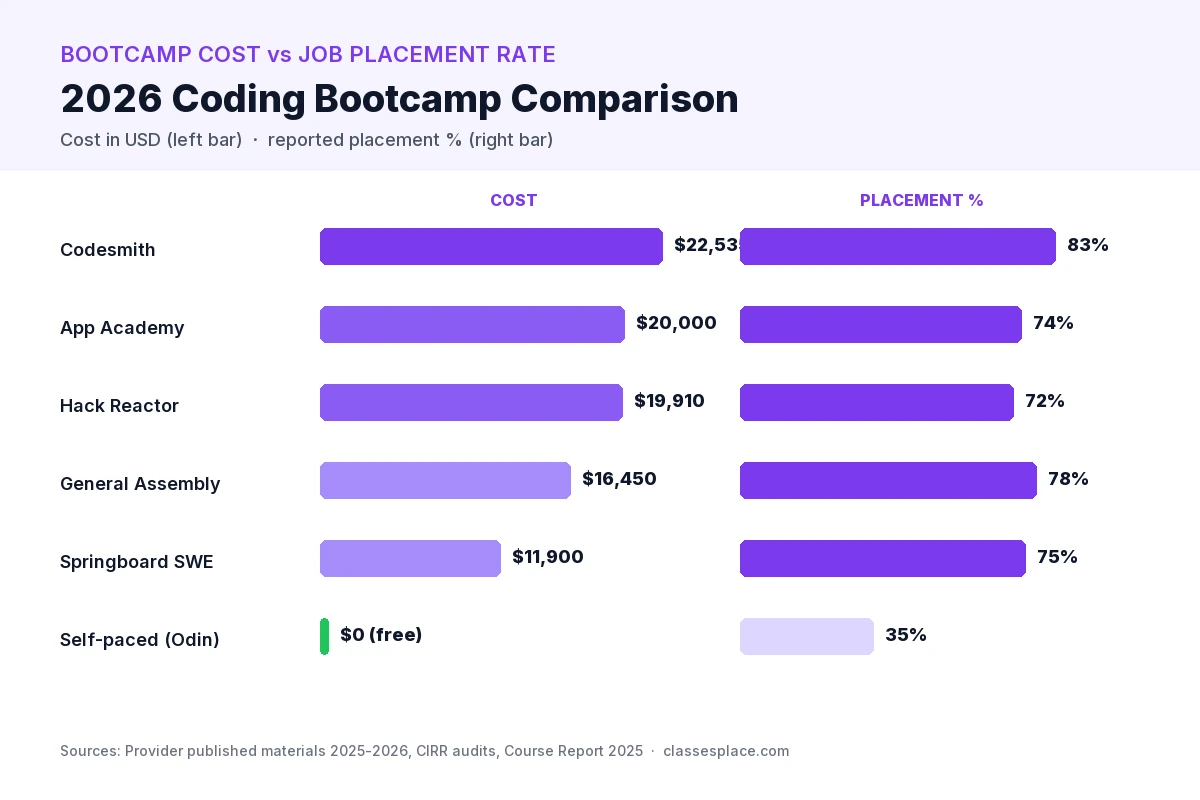
Coding bootcamp cost & outcome comparison (2026)
| Bootcamp | Cost | Duration | Format | Placement | Job Guarantee |
|---|---|---|---|---|---|
| Codesmith | $22,535 | 13 wk FT | Online | ~83% (CIRR audited) | No |
| App Academy | $20,000 / ISA | 16 wk FT / 24 wk PT | Online | ~74% self-reported | ISA option |
| Hack Reactor | $19,910 | 12 wk FT / 36 wk PT | Online | ~72% self-reported | No |
| Springboard SWE | $11,900 | 9 mo PT | Online + mentor | Tied to job guarantee | Yes (12-mo refund) |
| General Assembly | $16,450 | 13 wk FT / 24 wk PT | Online + in-person | ~78% self-reported | No |
| Self-paced (Odin + FCC) | $0–$50 | 9–18 mo | Self-directed | Variable | N/A |
Is a coding bootcamp worth it in 2026?
Yes for most career-changers, but with three honest caveats specific to 2026:
That said, the demand for software engineers remains strong overall. The U.S. Bureau of Labor Statistics projects software developer employment to grow approximately 17% from 2023 to 2033 — far faster than the average for all occupations. A well-prepared bootcamp graduate with a portfolio is still a hireable candidate.
Salary outcomes after a coding bootcamp
Reported 2026 starting salaries for coding bootcamp graduates in the US:
- Junior Software Engineer: $75,000–$95,000
- Front-end Developer: $72,000–$90,000
- Full-stack Developer: $78,000–$98,000
- Junior Backend Engineer: $80,000–$100,000
- Software Engineer (mid-level, from Codesmith / strong portfolio): $105,000–$135,000
For international remote engineers, the math shifts dramatically. A bootcamp graduate in Pakistan or India landing a remote-international engineering role typically earns 3–6× their local-market peers. See our remote tech job roadmap for Pakistan for the placement strategy.
Which coding bootcamp should you choose?
- You want the highest-rigor program and can pass technical admissions: Codesmith (mid-level placement outcomes, CIRR-audited).
- You work full-time and can’t quit: Springboard SWE Career Track (9 months part-time, job guarantee).
- You can dedicate 12–16 weeks full-time with savings: App Academy (ISA option) or Hack Reactor (cohort experience).
- You want global brand recognition or in-person option: General Assembly.
- You have under $100 and high self-discipline: The Odin Project + freeCodeCamp + a public GitHub portfolio.
Before committing tuition, attend at least one free trial session from your shortlist, ask for the most recent published placement data (and check whether it’s CIRR-audited), and message 3–5 alumni on LinkedIn to confirm the program’s actual outcomes match the marketing. The most expensive decision in your career change is picking the wrong bootcamp.
Coding bootcamps vs computer science degree
For most career-changers, a bootcamp is the faster, cheaper, more practical route into software engineering. A coding bootcamp takes 3–9 months and costs $0–$22,535. A computer science bachelor’s degree takes 4 years and costs $40,000–$200,000+. The bootcamp graduate can be earning $80,000+ before the CS degree student even graduates.
The CS degree wins in two specific situations: when you want to work at a FAANG-tier company with strict degree filters, or when you want to pursue specialized research-track roles (machine learning research, distributed systems, security research). For everyday software engineering work at most companies, the bootcamp path is rational.
Sources: Provider published materials (2025–2026), Council on Integrity in Results Reporting (CIRR) outcome audits, Course Report 2025 bootcamp outcomes survey, U.S. Bureau of Labor Statistics OES 15-1252 (Software Developers). Cost and duration figures reflect 2025–2026 published rates and may change. CIRR participation status verified for each program; programs not currently participating in CIRR are flagged inline.
Frequently asked questions
Are coding bootcamps still worth it in 2026?
Yes for most career-changers. Reputable bootcamps report 70–84% job-placement rates within 12 months, with graduates earning $75,000–$95,000 starting salaries in the US. Even a $22,535 Codesmith tuition pays back within 3 months of placement. The caveats: verify the program is still operating, prepare a portfolio of 3–5 public projects, and combine the bootcamp with active networking.
Which coding bootcamp has the highest job placement rate?
Codesmith reports the highest audited placement rate among major 2026 coding bootcamps at approximately 83% within 180 days, verified through the Council on Integrity in Results Reporting (CIRR). General Assembly and Springboard report comparable self-reported rates; App Academy and Hack Reactor stopped CIRR reporting after 2023.
What is the cheapest coding bootcamp in 2026?
The cheapest credible path is free — The Odin Project + freeCodeCamp + a public GitHub portfolio. Among paid bootcamps, Springboard SWE Career Track is the cheapest at $11,900, and it includes a job-refund guarantee. General Assembly at $16,450 is the next-cheapest paid option.
Can I get hired as a software engineer without a degree?
Yes. Most coding bootcamp graduates do not hold a computer science degree. Employers outside of top-tier FAANG roles generally accept a bootcamp credential plus a portfolio of public GitHub projects as evidence of competence. Demonstrable skill matters more than degree status for most software engineering roles in 2026.
How long does a coding bootcamp take?
Full-time bootcamps (Codesmith, App Academy, Hack Reactor, General Assembly) run 12–16 weeks. Part-time bootcamps (Springboard, Hack Reactor PT, App Academy PT) run 6–9 months at 15–25 hours per week. Self-paced learning via The Odin Project typically takes 9–18 months to reach hireable proficiency.
Do coding bootcamps offer financial aid?
Most major bootcamps offer financing through partners like Climb Credit or Ascent Funding, scholarship programs, and (at App Academy) income-share agreements where you pay a percentage of post-graduation salary instead of upfront tuition. Springboard’s job-refund structure functions similarly — you only effectively pay if you successfully land a role.
What is the difference between Codesmith and App Academy?
Codesmith targets students aiming for mid-level engineering roles and has a harder admissions bar; App Academy targets a broader range of career-changers and offers an income-share agreement option. Codesmith publishes CIRR-audited outcomes; App Academy stopped CIRR reporting after 2023. Both cost approximately $20,000 for the full-time program.