Last updated: May 2026 · Reading time: 12 minutes
Landing a remote tech job from Pakistan in 2026 isn’t easy — but it’s the most realistic path to a Western-level salary while living at home. The data tells a clear story: Pakistani developers earning $50K-$120K USD/year remotely have grown 4x since 2022. Most of them aren’t from FAST-NUCES or LUMS. Most don’t have CS degrees. They followed a specific roadmap that this guide lays out.
What actually works in 2026, based on tracking dozens of successful Pakistani remote workers on LinkedIn and X.
The Reality Check
Before the playbook, the honest truth:
- Most Pakistani developers earning $80K+ remote took 2-3 years from “started learning to code” to “got hired”
- Most got rejected from 50-200+ companies before their first offer
- Most don’t have a CS degree from a top university
- Most started with freelancing on Upwork before moving to full-time remote
- Almost all built strong English communication skills (this is the biggest filter)
If you’re hoping for a “30-day path to $100K”, close this article. The real path is 12-36 months of focused work.
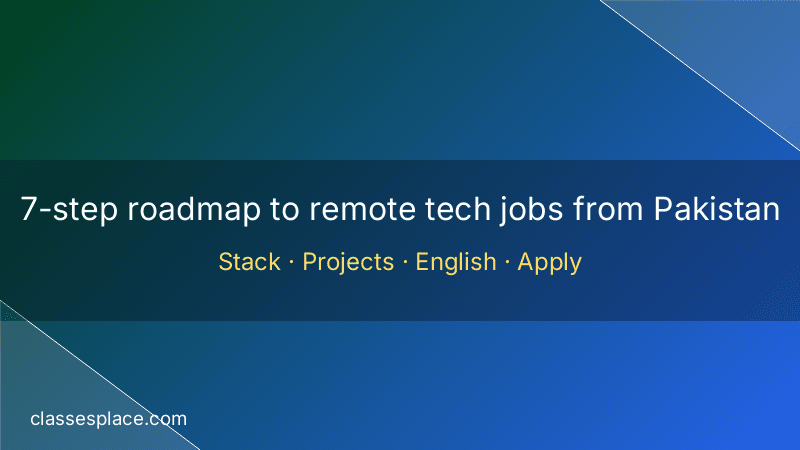
The 7-Step Roadmap That Actually Works in 2026
Step 1 — Pick One Tech Stack and Master It
The biggest mistake Pakistani developers make: trying to learn 5 stacks at once. Pick ONE and go deep.
The most hireable stacks in 2026 (US-remote market):
| Stack | Demand | Avg Remote Salary |
|---|---|---|
| React + TypeScript + Node.js | Very high | $60K-$130K |
| Python + Django/FastAPI | Very high | $70K-$140K |
| Next.js + Tailwind | High | $60K-$130K |
| Go + Postgres | High (less competition) | $80K-$160K |
| React Native / Flutter (mobile) | High | $60K-$120K |
| DevOps (AWS + Terraform + K8s) | Very high | $80K-$170K |
| Data Engineering (Python + SQL + Airflow) | High | $80K-$150K |
Avoid: PHP/WordPress (saturated, lower pay), Java (corporate, harder remote market), C# (mostly in-office).
Step 2 — Build 3-5 Real Projects (Not Tutorials)
Tutorials don’t get you hired. Projects with screenshots, deployed URLs, and source code do.
Project requirements that impress hiring managers:
- Solves a real problem (your own or a small business’s)
- Live deployed URL (Vercel, Netlify, or AWS)
- Public GitHub repo with clear README
- Mobile-responsive
- Has authentication and a database
- Documented architecture decisions
Examples that work:
- SaaS clone (e.g., Trello, Slack-like) — but with one unique feature you added
- Industry-specific app (real estate listing tool, dental booking system)
- Open source contribution to a known library (huge signal)
- Data dashboard for public dataset (housing prices, election data, etc.)
Step 3 — Get Your English to Native-Adjacent Level
This is the biggest underrated filter. Pakistani developers with strong English (clear written + comfortable on video calls) get hired at 3-5x the rate of equally-skilled developers with weaker English.
How to level up:
- Watch English tech podcasts (Lex Fridman, Software Engineering Daily) at 1.5x speed for 1 hour daily
- Use Grammarly + ChatGPT to refine all written communication
- Practice technical English on iTalki or with ChatGPT voice mode (30 min daily)
- Record yourself explaining technical concepts on video; review for clarity
Goal: someone reading your messages should not be able to tell you’re not a native speaker.
Step 4 — Build Your LinkedIn and GitHub Presence
LinkedIn checklist:
- Professional headshot (use a real one — AI faces look obvious)
- Headline: “{Stack} Engineer · Building {specific thing}” — not “Open to opportunities”
- About section: 3-4 paragraphs about your specific expertise
- Add all your projects with images and demo links
- Post 1-2 technical insights per week (LinkedIn algorithm rewards consistency)
- Comment thoughtfully on 5-10 posts daily in your niche
GitHub checklist:
- Real-name profile (not “fakeUsername123”)
- Pinned 6 best projects
- Green contribution graph (commit at least 3-4x weekly)
- Each repo has a quality README with screenshots
- Contribute to 1-2 popular open source projects
Step 5 — Start with Freelance Before Full-Time Remote
Most Pakistanis who land $100K+ remote jobs start by freelancing on Upwork or Fiverr first. The reasons:
- Builds international client experience visible on resume
- Generates income while you upskill
- Provides English communication practice
- Lets you ask for testimonials/recommendations
Target: $30-50/hour on Upwork within 6-12 months. By the time you start applying for full-time remote roles, you have 12+ months of “real client work” experience.
Step 6 — Apply to the RIGHT Companies
Don’t apply to FAANG companies first. They have visa requirements and prefer in-person.
Companies that actually hire Pakistani remote talent in 2026:
- Toptal, Andela, Turing — vetted talent platforms (rigorous interview but legitimate)
- Y Combinator startups — many hire globally; check yc.com/jobs
- Remote-first companies — GitLab, Automattic, Buffer, Doist, Zapier
- European startups — fewer visa complications than US
- Web3/crypto companies — heavily remote, pay well
- Marketing/SaaS startups in Australia, NZ (high pay, fewer applicants)
Job boards to use daily:
- WeWorkRemotely.com
- Remotive.com
- RemoteOK.com
- Dice (US tech-focused)
- YC Work at a Startup
- Wellfound (formerly AngelList)
Step 7 — Master the Interview Loop
Remote tech interviews typically have 4 stages:
- Recruiter screen (30 min) — gauging English, motivation, salary expectations
- Technical screen (45-60 min) — coding problem, often on CoderPad
- System design or take-home (1-3 days) — varies by role
- Final round with team/leadership — culture fit, deeper technical
Preparation:
- LeetCode 100-150 problems (focus on Easy and Medium; skip Hard for most roles)
- System design: read “System Design Primer” on GitHub + watch ByteByteGo videos
- STAR-format behavioral answers prepared for 8-10 common questions
- Mock interviews with peers or on Pramp/Interviewing.io
Salary Expectations by Experience Level (May 2026)
| Level | Years | Pakistan Local Job | Remote US Job |
|---|---|---|---|
| Junior | 0-2 | PKR 80K-200K/mo | $30K-60K/year |
| Mid | 2-5 | PKR 200K-450K/mo | $60K-100K/year |
| Senior | 5-8 | PKR 450K-800K/mo | $100K-160K/year |
| Staff/Principal | 8+ | PKR 800K+/mo | $150K-250K+/year |
Conversion: $80K USD = ~PKR 22 million/year = ~PKR 1.8 million/month. About 4x what local Pakistani tech jobs pay at the same level.
Common Mistakes That Get Pakistani Devs Rejected
- Generic applications — same resume to 100 jobs gets 0 responses. Tailor each one
- Weak English — even strong code can’t compensate for unclear communication
- Empty GitHub — “I built it locally” is a non-starter
- Asking salary too early — only after they’ve shown clear interest
- Bad interview setup — quiet space, good lighting, fast internet, English-keyboard, working webcam
- Misrepresenting experience — easy to detect, ends careers
How to Get Paid as a Remote Worker in Pakistan
- Wise (formerly TransferWise) — best for direct deposits from international employers
- Payoneer — accepted by most companies, good for Upwork/freelance
- Deel.com — used by remote-first companies; pays in PKR or USD
- Crypto stablecoins (USDT) — for Web3 companies; convert via Binance P2P
Tax: register with SECP and FBR if earning consistently from international clients. Remote tech income above PKR 600K/year requires filing.
The Realistic Timeline
- Months 1-3: Pick stack, build 1st project, improve English daily
- Months 4-6: Build 2 more projects, start Upwork freelancing
- Months 7-9: Hit $1K-3K/month freelance, build LinkedIn presence
- Months 10-12: Apply to 100-200 remote roles, do mock interviews
- Months 13-15: Land first full-time remote offer
- Years 2-3: Switch jobs every 12-18 months for raises (40-80% jumps)
Most successful Pakistani remote devs hit $80K+/year by year 2-3 from when they started focused work.
Frequently Asked Questions
Can I get a remote tech job in Pakistan without a CS degree?
Yes. Most Pakistani developers earning $50K+ remote in 2026 don’t have CS degrees from elite universities. Companies hire on demonstrated skill (projects, GitHub, portfolio) more than credentials. A computer science degree is helpful but not required.
How much can a Pakistani remote developer earn in 2026?
Realistic range: $30K-60K/year for juniors, $60K-100K for mid-level, $100K-160K for seniors. Top performers in specialized areas (DevOps, ML, Senior Backend) can clear $200K+. Conversion: roughly PKR 8-50 million per year, 3-5x typical local Pakistani tech salaries.
Which programming language is best for remote jobs from Pakistan?
JavaScript/TypeScript (with React + Node.js) has the most remote demand in 2026. Python (with Django/FastAPI) is a close second, especially in data and AI roles. Go and Rust have less competition and pay slightly higher per role. Avoid PHP and outdated stacks.
Do I need an LLC or company to get hired remotely?
No. Most companies hire Pakistani remote workers as contractors via platforms like Deel, Remote.com, or directly. They handle compliance. Some companies require you to register a sole proprietorship in Pakistan (10-15 minutes online via SECP).
How long does it really take to get the first remote tech job?
For someone starting from zero coding experience: 18-30 months of focused 20-30 hours/week effort. For someone with existing local job experience: 6-12 months of focused job hunting. The job hunt itself usually takes 100-200 applications and 4-8 interview loops.
What’s the biggest challenge for Pakistani remote workers?
Time zones. Most remote-first US companies operate 6-9 PM Pakistan time (their morning). You’ll work evening/night hours. Some prefer European/Australian companies for better timezone overlap. Internet reliability is the second challenge — invest in dual ISPs or 4G backup.
Sources
- Tracked Pakistani LinkedIn profiles of remote developers, May 2026
- Wellfound and Remote.com salary data, 2026
- State Bank of Pakistan IT freelance income statistics
- Tested by Classes Place editorial team
Last updated: May 2026. Salary ranges vary significantly by role, company, and individual experience. No specific income outcome is guaranteed.
Related Reading