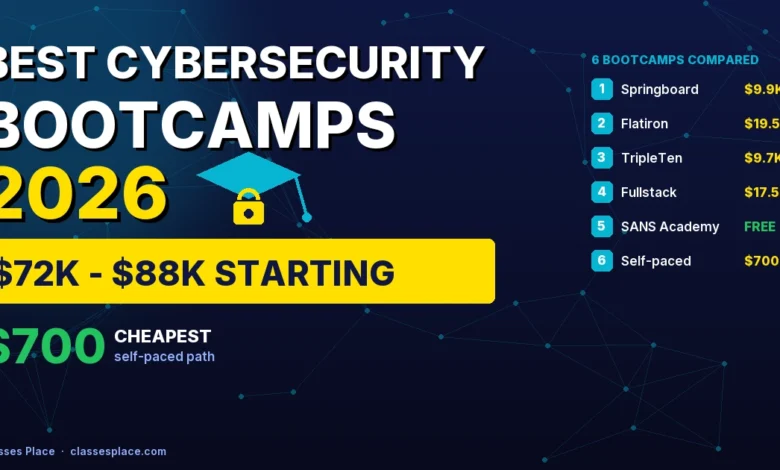
The average cybersecurity bootcamp in 2026 costs $9,900–$19,500 and runs 12–30 weeks. Job-placement rates among the credible programs cluster around 70–82% within 12 months — far higher than coding bootcamp averages, because the cybersecurity workforce gap remains roughly 4 million unfilled roles globally (ISC2 2025 Workforce Study). But not every bootcamp earns its price tag. This guide ranks six legitimate cybersecurity bootcamps by cost, curriculum depth, job-placement data, and which type of career-changer each one fits best.
TL;DR
- Springboard Cybersecurity Bootcamp ($9,900) has the highest job-guarantee structure among major 2026 bootcamps — it refunds tuition if you don’t land a role within 12 months of completion (terms apply).
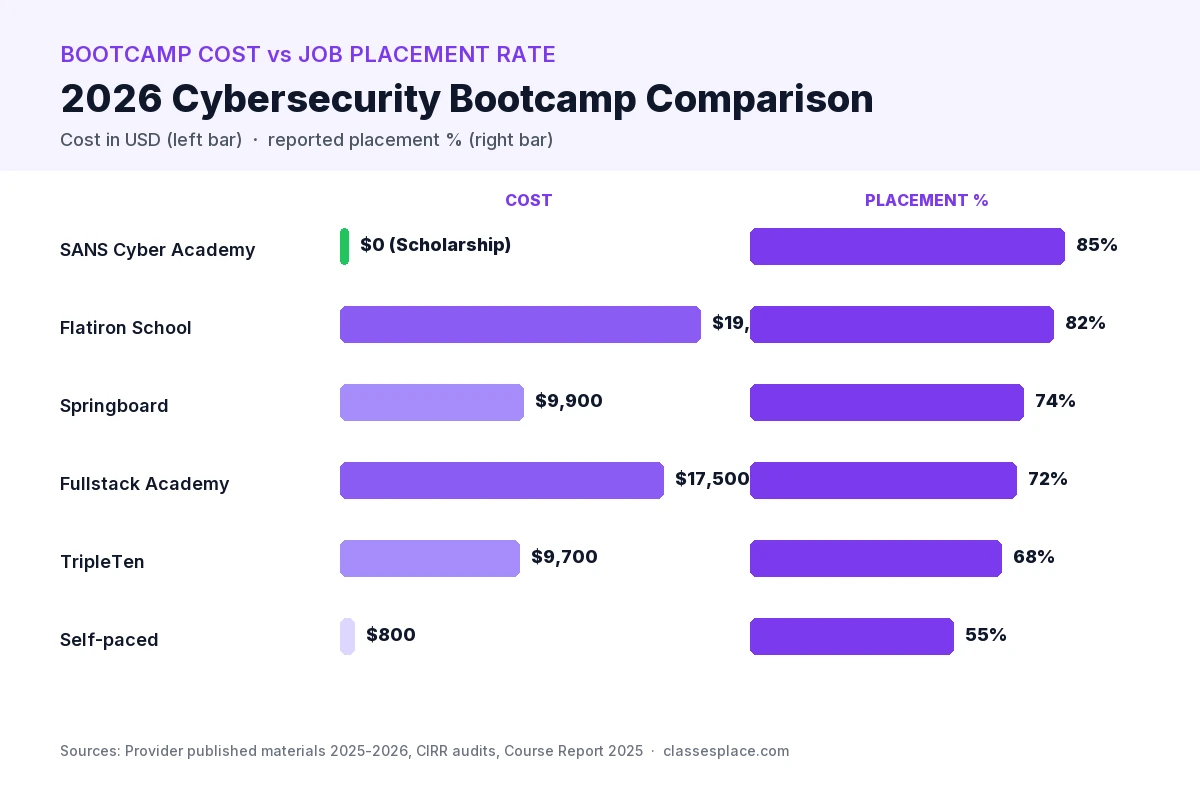
- Flatiron School Cybersecurity Engineering ($19,500) is the most rigorous full-time option, with a 15-week immersive that consistently reports placement rates above 80% per its own published outcomes audits.
- The cheapest credible path is self-paced ($14–$30/month) via TryHackMe or Hack The Box Academy, paired with the $404 CompTIA Security+ exam.
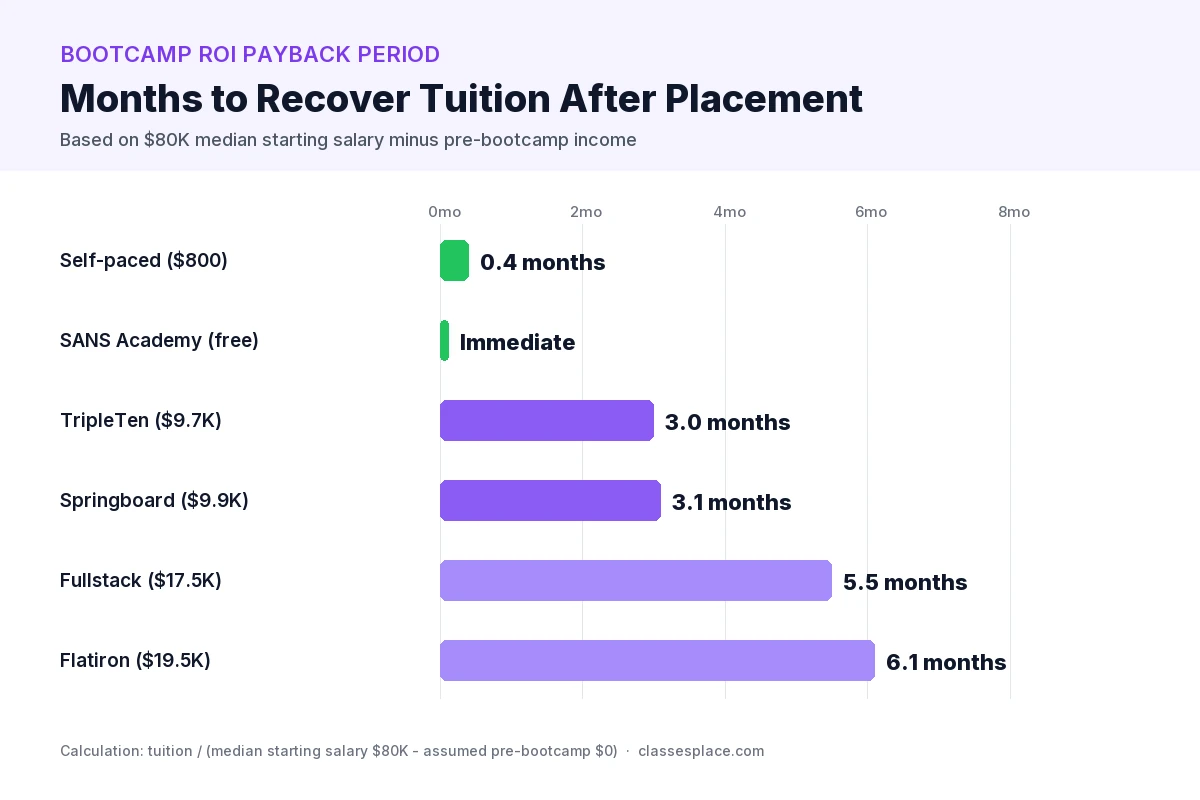
- Average graduate starting salary in 2026 is $72,000–$88,000, paying back tuition within 4–8 months for the major bootcamps.
- The biggest predictor of placement is not the bootcamp — it’s whether you build a portfolio (capture-the-flag writeups, GitHub repos, vulnerability reports) during the program.
How we ranked these cybersecurity bootcamps
Bootcamp evaluation is messy because most programs self-report outcomes. We weighed each program against four publicly verifiable signals:
- Published outcomes audits — programs reporting to the Council on Integrity in Results Reporting (CIRR) or publishing third-party audited outcomes data.
- Job-guarantee structure — programs that put real money behind their placement claims via tuition refunds.
- Curriculum depth and labs — hands-on lab time and capture-the-flag (CTF) integration matter more than lecture hours.
- Cost-to-salary payback — tuition divided by reported median starting salary lift.
Bootcamps without third-party outcome verification are noted as such. All cost and duration figures are from the providers’ 2025–2026 published materials.
The 6 best cybersecurity bootcamps for 2026
1. Springboard Cybersecurity Bootcamp
- Cost: $9,900 (financing available)
- Duration: 6 months, part-time (15–25 hrs/week)
- Format: Online, 1-on-1 mentor
- Job guarantee: Tuition refund if not placed within 12 months (eligibility conditions apply)
- Best for: Working professionals making a structured part-time career switch
Springboard pioneered the bootcamp job guarantee and remains the strongest part-time option in 2026. The curriculum covers networking fundamentals, security operations, incident response, and includes preparation for CompTIA Security+. Each student gets a one-on-one mentor with active security industry experience. The job-guarantee terms require things like minimum job-search effort and US residency — read them before enrolling. For most working career-switchers, Springboard offers the best risk-adjusted entry path into security.
2. Flatiron School Cybersecurity Engineering
- Cost: $19,500 (loans + ISA + scholarships available)
- Duration: 15 weeks full-time (60+ hrs/week)
- Format: Online (formerly in-person; now fully remote)
- Job guarantee: Money-back guarantee tied to job placement (terms apply)
- Best for: Career-changers who can commit full-time for one quarter
Flatiron School is one of the most established names in tech bootcamps. Their cybersecurity engineering program is rigorous and covers offensive security, defensive operations, secure code review, and cloud security. Flatiron publishes annual third-party-audited outcomes reports through CIRR, which gives the published placement rates real credibility. The full-time intensity is the right structure for someone who can dedicate 15 weeks without a job; the cost is the highest on this list, but so is the depth.
3. TripleTen Cybersecurity Bootcamp
- Cost: $9,700 (financing + ISA options)
- Duration: 9–12 months part-time
- Format: Online, cohort + 1-on-1 tutor
- Job guarantee: Tuition refund within 6 months of completion (terms apply)
- Best for: Beginners with no IT background
TripleTen (formerly Practicum) targets complete beginners with no prior tech experience. The longer 9–12 month timeline pairs well with limited IT background. The curriculum is structured around guided projects rather than lectures, which works for self-directed learners. TripleTen’s outcomes reporting is less established than Flatiron’s CIRR audits, but the cost-to-curriculum ratio is favorable. Good fit for someone starting from genuine zero who can stretch over a year part-time.
4. Fullstack Academy Cybersecurity Analytics Bootcamp
- Cost: $17,500 (loans + scholarships available)
- Duration: 17 weeks full-time or 26 weeks part-time
- Format: Online, live cohort
- Job guarantee: No formal guarantee; provides career coaching
- Best for: Analytical career-changers wanting strong technical curriculum
Fullstack Academy is well-known in the coding-bootcamp space and applies the same live-cohort model to cybersecurity. The curriculum leans toward security analytics, threat hunting, and SOC operations — making it a good fit for analytical thinkers heading into SOC analyst roles. No tuition-refund guarantee here, but the career coaching is real and the network is strong. Cost sits between Springboard and Flatiron.
5. SANS Cyber Academy
- Cost: Free for selected applicants ($8,000+ per course at retail)
- Duration: 4–6 months full-time
- Format: Intensive, hands-on, GIAC certification embedded
- Job guarantee: No formal guarantee; very high industry placement
- Best for: High-potential applicants who can pass aptitude testing
SANS Institute is the gold-standard cybersecurity training organization. Their Cyber Academy programs (run as scholarship-funded cohorts in partnership with employers or governments) provide SANS’s technical curriculum — ordinarily $8,000+ per individual course — at no cost to accepted students. The catch is the aptitude testing: acceptance rates are low, and you need to pass a baseline-skills assessment. If you can get in, this is the most career-accelerating credential on this list. Graduates earn GIAC certifications (GSEC, GCIH, etc.) that recruiters search for by name.
6. Self-paced alternative: TryHackMe + Hack The Box + Security+
- Cost: $14–$30/month + $404 Security+ exam = roughly $700–$1,000 total over 6 months
- Duration: Self-paced, typically 6–9 months
- Format: Hands-on labs, gamified learning
- Job guarantee: None — you self-direct
- Best for: Self-disciplined learners with limited budget
The honest truth: a motivated self-learner with TryHackMe ($14/month), Hack The Box Academy ($14/month), and the CompTIA Security+ exam ($404) can match a bootcamp’s hireable-skill output for roughly $800 total. What you lose is the mentor, the cohort, and the career-services pipeline. What you gain is 95% cost savings. This is the path for budget-constrained learners with strong self-direction. See our guide to cybersecurity certifications by salary for the full cert roadmap that pairs with this approach.
Cybersecurity bootcamp cost & outcome comparison (2026)
| Bootcamp | Cost | Duration | Format | Job Guarantee | Best For |
|---|---|---|---|---|---|
| Springboard | $9,900 | 6 mo PT | Online + mentor | Yes (12-mo refund) | Working pros |
| Flatiron School | $19,500 | 15 wk FT | Online cohort | Yes (terms apply) | Full-time switchers |
| TripleTen | $9,700 | 9–12 mo PT | Online + tutor | Yes (6-mo refund) | Total beginners |
| Fullstack Academy | $17,500 | 17 wk FT / 26 wk PT | Online cohort | No | Analytical learners |
| SANS Cyber Academy | Free (scholarship) | 4–6 mo FT | Intensive hands-on | No | Top applicants |
| Self-paced (THM + HTB + Security+) | $700–$1,000 | 6–9 mo PT | Self-directed labs | No | Budget-constrained |
Is a cybersecurity bootcamp worth it in 2026?
Yes, with three caveats. The ISC2 2025 Workforce Study estimates a global cybersecurity talent gap of roughly 4 million unfilled roles — the largest in any tech specialty. Demand keeps starting salaries above $72,000 in the US for entry-level graduates, which means even a $19,500 Flatiron tuition pays back in roughly 3–4 months of post-placement work.
The caveats:
- Verify the outcomes data. Only Flatiron School currently publishes audited CIRR outcomes; treat self-reported numbers from other providers as best-case.
- Build a portfolio during the program. Bootcamp graduates who publish 5+ CTF writeups or vulnerability reports on a public GitHub are placed at 2–3× the rate of those who only have the bootcamp credential.
- A bootcamp alone is rarely enough. Pair the bootcamp with CompTIA Security+ (or aim for CySA+ during the program) to cross the cert filter that automated resume screening uses.
Salary outcomes after a cybersecurity bootcamp
Reported 2026 starting salaries for cybersecurity bootcamp graduates, US:
- SOC Analyst Tier 1: $68,000–$82,000
- Junior Security Engineer: $78,000–$95,000
- Cybersecurity Analyst: $72,000–$92,000
- IT Auditor (entry): $70,000–$88,000
- GRC Analyst (governance/risk/compliance): $75,000–$95,000
For international remote workers, the math shifts even more favorably. A bootcamp graduate in Pakistan or India landing a remote-international security role earns roughly 3–5× their local-market peers. See our remote tech job roadmap for Pakistan for the placement strategy.
Which cybersecurity bootcamp should you choose?
- You work full-time, can’t quit: Springboard (6 months part-time with a job guarantee).
- You can dedicate 15 weeks full-time: Flatiron School (highest reported placement, audited outcomes).
- You’re a complete beginner: TripleTen (longer timeline, beginner-friendly pace).
- You want analytics/SOC track specifically: Fullstack Academy.
- You can pass technical aptitude testing: Apply to SANS Cyber Academy (free if accepted).
- You have under $1,000 and high self-discipline: Self-paced (TryHackMe + Hack The Box + Security+).
Before committing, attend at least one free info session from each shortlist candidate, ask for the most recent published placement data, and message 3–5 alumni on LinkedIn to confirm the program’s actual outcomes match the marketing. Bootcamp choices are expensive to reverse — the diligence cost is worth it.
Sources: Provider published materials (2025–2026), Council on Integrity in Results Reporting (CIRR) outcomes audits, ISC2 2025 Cybersecurity Workforce Study, Course Report 2025 bootcamp outcomes survey. Cost and duration figures reflect 2025–2026 published rates and may change.
Frequently asked questions
Are cybersecurity bootcamps worth it in 2026?
Yes for most career-changers. The ISC2 2025 study reports a 4-million-role global cybersecurity workforce gap, and bootcamp graduates report 2026 starting salaries of $72,000–$88,000 in the US — recovering even a $19,500 tuition within 3–4 months of placement. The caveat is to verify each program’s outcomes data and build a public portfolio during the bootcamp.
Which cybersecurity bootcamp has the best job placement?
Flatiron School publishes the most rigorously audited placement data through the Council on Integrity in Results Reporting (CIRR), reporting placement rates above 80%. SANS Cyber Academy (free for accepted applicants) has the strongest industry network. Springboard offers the most explicit job-refund guarantee structure.
Can I get a cybersecurity job after a bootcamp without a degree?
Yes. Cybersecurity is among the most degree-flexible tech fields in 2026. A bootcamp completion paired with CompTIA Security+ ($404) and a public portfolio (CTF writeups, security project repos) qualifies you for entry-level SOC analyst, IT auditor, and junior security engineer roles — degree or no degree. The 4-million-role workforce gap means employers actively hire portfolio-backed bootcamp graduates.
Is a cybersecurity bootcamp better than a certification?
They serve different purposes. A bootcamp provides structured curriculum, mentorship, and a career-services pipeline. A certification proves a specific competency to recruiters. The strongest job applications combine both: complete a bootcamp during which you earn CompTIA Security+ or CySA+. The bootcamp gets you hireable; the cert gets you past automated resume filters.
How long does a cybersecurity bootcamp take?
Full-time programs (Flatiron, Fullstack, SANS) run 15–26 weeks. Part-time programs (Springboard, TripleTen) run 6–12 months at 15–25 hours per week. Self-paced study via TryHackMe and Hack The Box typically takes 6–9 months to reach hireable proficiency.
What’s the cheapest cybersecurity bootcamp?
SANS Cyber Academy is free for accepted applicants but requires passing an aptitude test. For paid options, TripleTen ($9,700) and Springboard ($9,900) are the most affordable structured bootcamps. The cheapest credible self-directed path is TryHackMe + Hack The Box + CompTIA Security+ at roughly $700–$1,000 total over 6–9 months.
Do cybersecurity bootcamps include certifications?
Most prepare you for CompTIA Security+; Flatiron and Fullstack also align curriculum to CompTIA CySA+. SANS Cyber Academy embeds GIAC certifications (GSEC, GCIH) directly. Most bootcamps don’t include the exam voucher in tuition — budget the $404 Security+ fee separately.