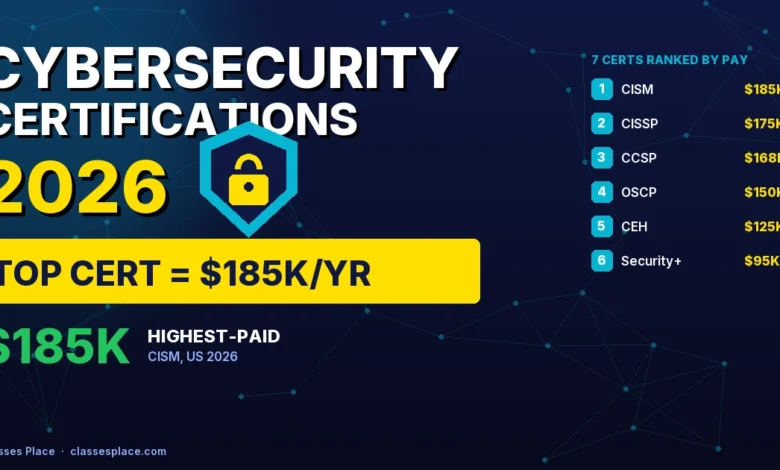
The highest-paying cybersecurity certification in 2026 is CISM (Certified Information Security Manager), with US holders reporting a median base salary near $170,000 — closely followed by CISSP and CCSP. But the certification with the best return on investment isn’t the most expensive one. This guide ranks seven cybersecurity certifications by 2026 salary data, exam cost, and difficulty, then tells you exactly which to get first based on your experience level.
TL;DR
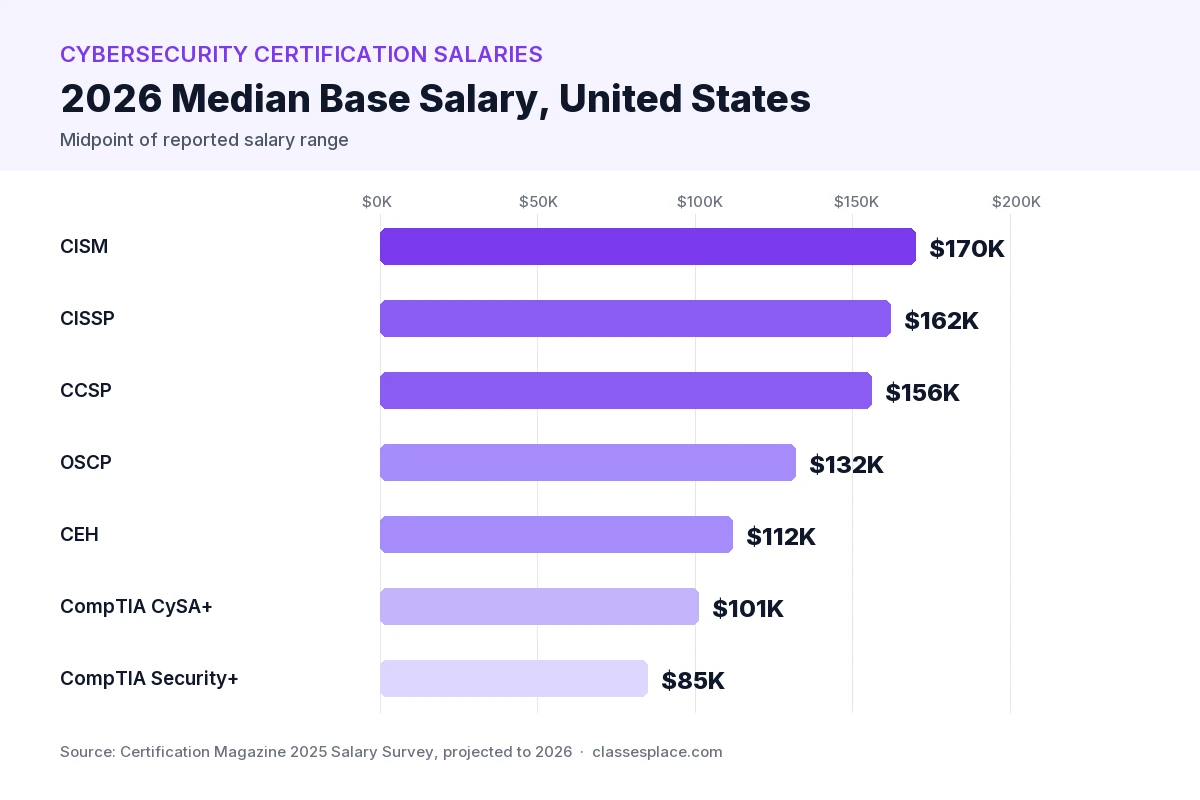
- CISM and CISSP are the highest-paying cybersecurity certifications in 2026, with US median base salaries of roughly $165,000–$170,000 (Certification Magazine 2025 Salary Survey, projected forward).
- CompTIA Security+ is the best entry-level certification — a $404 exam that unlocks roles paying $75,000–$95,000 and is required for many U.S. government and defense jobs.
- The fastest-payback certification is CompTIA Security+, returning its cost within roughly one month of a successful job change.
- Management-track certifications (CISM, CISSP) out-earn technical certifications because they qualify you for security leadership roles, not just analyst positions.
- You cannot start with CISSP or CISM — both require 4–5 years of verified experience. Beginners must start with Security+ and build up.
How we ranked these cybersecurity certifications
Salary figures in this guide are based on publicly available 2025 data, projected to 2026:
- Certification Magazine 2025 Salary Survey — annual self-reported salary data segmented by individual certification.
- ISC2 2025 Cybersecurity Workforce Study — for CISSP and CCSP holder compensation and the global workforce gap.
- Skillsoft IT Skills and Salary Report 2025 — for cross-certification salary comparison.
- CyberSeek (NIST / Lightcast) — for U.S. cybersecurity job demand and role-level pay.
2026 figures apply a 3.5% projected wage adjustment for cybersecurity roles — above the general tech average, because the cybersecurity workforce gap (an estimated 4 million unfilled roles globally per the ISC2 2025 study) continues to push compensation up. Where a number is a projection rather than reported actual, we say so.
The 7 highest-paying cybersecurity certifications in 2026
1. CISM — Certified Information Security Manager
- 2026 median salary (US): $155,000–$185,000
- Exam cost: $760 (ISACA member) / $799 (non-member)
- Experience required: 5 years in information security management
- Best for: Security professionals moving into leadership and governance roles
CISM is the highest-paying cybersecurity certification in 2026 because it certifies management capability, not just technical skill. CISM holders move into security manager, IT director, and CISO-track roles — positions that pay a leadership premium. The certification is issued by ISACA and focuses on governance, risk management, and incident response from a business perspective. It is not an entry point; the 5-year experience requirement makes it a mid-to-late-career credential.
2. CISSP — Certified Information Systems Security Professional
- 2026 median salary (US): $150,000–$175,000
- Exam cost: $749
- Experience required: 5 years across 2+ of the 8 CISSP domains
- Best for: Experienced security engineers and architects
CISSP is the most widely recognized cybersecurity certification in the world and the one that appears most often in senior job descriptions. Issued by ISC2, it covers eight domains spanning security architecture, asset security, and software development security. CISSP is broader and more technical than CISM; CISM is more management-focused. Many senior professionals eventually hold both. If you can only choose one and you’re on a technical track, choose CISSP.
3. CCSP — Certified Cloud Security Professional
- 2026 median salary (US): $145,000–$168,000
- Exam cost: $599
- Experience required: 5 years IT, 3 in security, 1 in cloud security
- Best for: Security professionals specializing in cloud (AWS, Azure, GCP)
CCSP, also from ISC2, is the fastest-growing high-salary cybersecurity certification because nearly every organization now runs critical workloads in the cloud. It pairs naturally with a cloud engineering background — if you already hold an AWS or Azure certification, CCSP is the highest-value security specialization to add. See our AWS vs Azure certification comparison for the cloud-platform groundwork.
4. OSCP — Offensive Security Certified Professional
- 2026 median salary (US): $115,000–$150,000
- Exam cost: ~$1,649 (course + exam bundle)
- Experience required: None formally, but strong technical skills assumed
- Best for: Aspiring penetration testers and red-team engineers
OSCP is the most respected hands-on offensive security certification. Unlike multiple-choice exams, OSCP requires you to actually compromise live machines in a 24-hour practical exam. It carries enormous credibility with employers precisely because it cannot be passed by memorization. It’s the gold-standard credential for penetration testing and ethical hacking careers. The cost is higher because it bundles a structured training course.
5. CEH — Certified Ethical Hacker
- 2026 median salary (US): $100,000–$125,000
- Exam cost: ~$1,199 (exam voucher)
- Experience required: 2 years security experience, or official training
- Best for: Security analysts moving toward offensive roles; resume keyword value
CEH, issued by EC-Council, is more theoretical than OSCP — it’s a multiple-choice exam covering hacking concepts, tools, and methodology. Its main value is recruiter recognition: many HR systems search for “CEH” by name, and it satisfies U.S. Department of Defense Directive 8570 baseline requirements. For the practical skill signal, OSCP is stronger; for the resume keyword and government-job eligibility, CEH still earns its place.
6. CompTIA CySA+ — Cybersecurity Analyst
- 2026 median salary (US): $90,000–$112,000
- Exam cost: $404
- Experience required: None formally; Security+ knowledge recommended first
- Best for: Security analysts, SOC (Security Operations Center) roles
CySA+ is the natural step up from Security+. It focuses on threat detection, behavioral analytics, and incident response — the day-to-day work of a security operations center analyst. At $404, it’s one of the best value certifications on this list: a modest exam fee for a credential that moves you from entry-level into a specialized analyst role.
7. CompTIA Security+ — the entry point
- 2026 median salary (US): $75,000–$95,000
- Exam cost: $404
- Experience required: None
- Best for: Anyone entering cybersecurity with no prior certification
Security+ is where almost every cybersecurity career begins. It’s vendor-neutral, has no experience prerequisite, and is explicitly approved for U.S. Department of Defense IT roles under Directive 8570. It won’t make you a high earner on its own, but it gets you hired into your first security role — and every certification above builds on the foundation it teaches. If you’re starting from zero, this is the cert to get first.
Cybersecurity certification salary comparison (2026)
| Certification | 2026 Median Salary (US) | Exam Cost | Level | Experience Req. |
|---|---|---|---|---|
| CISM | $155K–$185K | $760 | Management | 5 years |
| CISSP | $150K–$175K | $749 | Senior technical | 5 years |
| CCSP | $145K–$168K | $599 | Cloud specialist | 5 years |
| OSCP | $115K–$150K | ~$1,649 | Offensive | None |
| CEH | $100K–$125K | ~$1,199 | Offensive (theory) | 2 years |
| CompTIA CySA+ | $90K–$112K | $404 | Analyst | None |
| CompTIA Security+ | $75K–$95K | $404 | Entry | None |
Certification cost vs. salary payoff
The most expensive certification is not the highest earner. OSCP costs ~$1,649 but earns less than CISM, which costs $760. Here’s the honest cost-to-payoff read:
- Best value: CompTIA Security+ — $404 to unlock a $75K–$95K career floor.
- Best mid-career value: CCSP — $599 for a $145K–$168K cloud-security salary band.
- Highest absolute earnings: CISM — $760 exam, but you need 5 years of management experience to qualify.
- Most expensive relative to salary: CEH — ~$1,199 for a $100K–$125K band that OSCP beats at a similar cost.
Cybersecurity salary by region
Cybersecurity compensation varies sharply by location. Here is the 2026 median for a CISSP-level security professional, USD-equivalent:
- United States: $150,000–$175,000
- United Kingdom: £72,000 (~$92,000 USD)
- Western Europe: €75,000 (~$81,000 USD)
- India: ₹22,00,000 (~$26,000 USD) for local roles; ~$70,000 USD for remote-international contracts
- Pakistan: PKR 3,200,000 (~$11,500 USD) for local roles; ~$55,000 USD for remote-international contracts
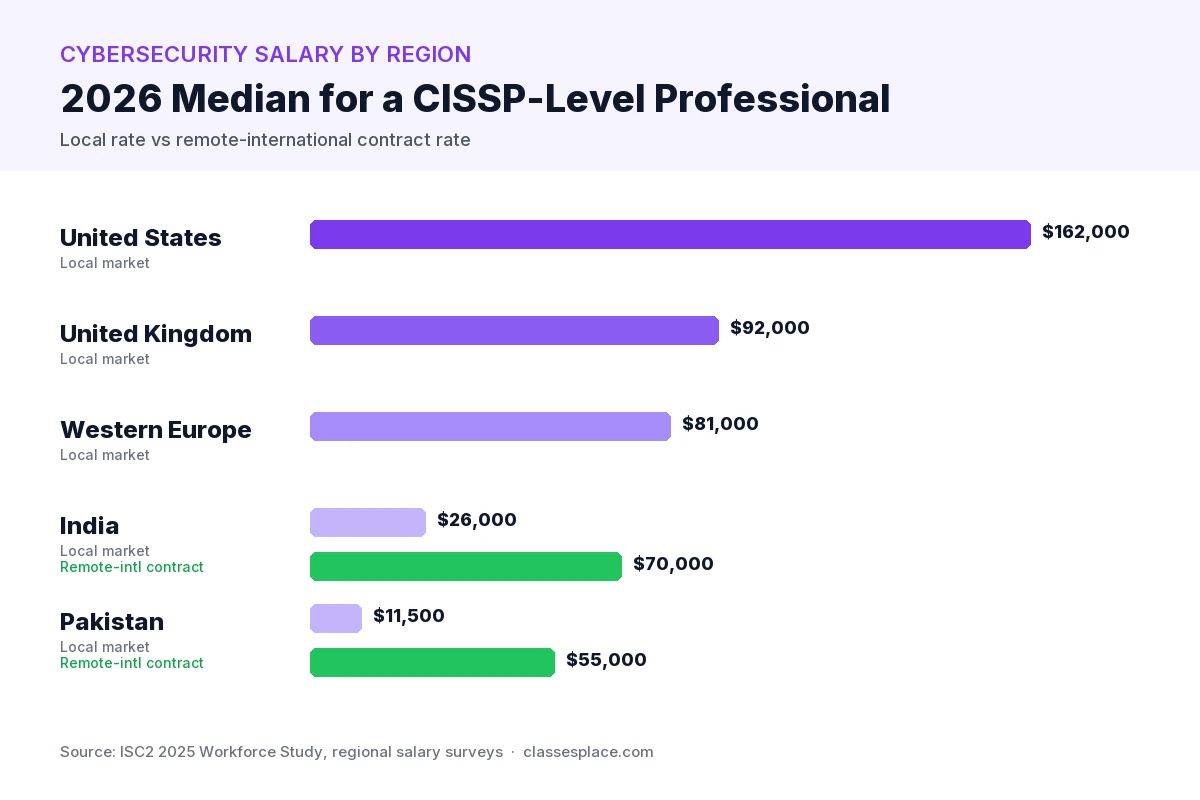
As with AI engineering roles, the remote-work premium is the biggest lever for professionals outside the US. A CISSP-certified security analyst in Pakistan or India on a remote-international contract earns roughly 3–5× the local rate. Our remote tech job roadmap for Pakistan covers how to land those contracts.
Which cybersecurity certification should you get first?
Pick based on where you are right now:
- No IT or security experience: Start with CompTIA Security+. It has no prerequisites and is the universal entry credential.
- 1–2 years in IT, moving into security: Security+ first, then CompTIA CySA+ to specialize as an analyst.
- You want offensive security / penetration testing: Security+ for the base, then OSCP. Skip CEH unless a specific job posting requires it.
- 5+ years of security experience, technical track: CISSP.
- 5+ years of security experience, leadership track: CISM.
- Cloud engineering background: CCSP — it converts your cloud skills into a security-salary premium.
The entry-level path with no experience
If you’re starting from zero, here is the realistic 12-month path into a cybersecurity career:
- Months 1–3: Earn CompTIA Security+. Budget 80–120 study hours.
- Months 3–5: Apply for SOC analyst, IT security, or help-desk-with-security roles. Security+ alone qualifies you for many of these.
- Months 6–9: While working, study for CompTIA CySA+ to move into a dedicated analyst role.
- Months 10–12: Choose your specialization — cloud security (toward CCSP), offensive security (toward OSCP), or governance (toward CISM later).
Cybersecurity is one of the few high-paying tech fields where you can get hired with a single $404 certification and no degree. The 4-million-role global workforce gap means employers are actively lowering barriers to entry. For a broader view of degree-free tech paths, see our guide to free AI certifications.
ROI: how fast each certification pays for itself
Using the 2026 median salary lift and total certification cost (exam plus study time at a $50/hour opportunity cost):
| Certification | Total Cost (exam + study time) | Typical Year-1 Salary Gain | ROI Payback |
|---|---|---|---|
| CompTIA Security+ | ~$5,400 | ~$78,000 (first security job) | under 1 month |
| CompTIA CySA+ | ~$4,400 | ~$15,000 (analyst step-up) | 3.5 months |
| CCSP | ~$6,600 | ~$25,000 (cloud security premium) | 3.2 months |
| CISSP | ~$7,250 | ~$28,000 (senior premium) | 3.1 months |
| CISM | ~$7,260 | ~$30,000 (management premium) | 2.9 months |
| OSCP | ~$8,150 | ~$22,000 (pentest premium) | 4.4 months |
Every certification on this list pays for itself within five months of a successful job change. CompTIA Security+ has the strongest ROI of any tech certification we’ve analyzed, because it converts “no security job” into “$78,000 security job” for a $404 exam fee.
Sources: Certification Magazine 2025 Salary Survey, ISC2 2025 Cybersecurity Workforce Study, Skillsoft IT Skills and Salary Report 2025, CyberSeek (NIST/Lightcast). 2026 figures are 2025 actuals adjusted for a 3.5% cybersecurity wage projection.
Frequently asked questions
Which cybersecurity certification pays the most in 2026?
CISM (Certified Information Security Manager) pays the most, with a 2026 US median base salary of $155,000–$185,000. It out-earns technical certifications because it qualifies holders for security management and CISO-track leadership roles. CISSP and CCSP follow closely behind.
What is the best entry-level cybersecurity certification?
CompTIA Security+ is the best entry-level cybersecurity certification. It costs $404, has no experience prerequisite, and is approved for U.S. Department of Defense IT roles. It unlocks first security jobs paying $75,000–$95,000 and is the foundation every other security certification builds on.
Can I get a cybersecurity job without a degree?
Yes. Cybersecurity is one of the most degree-flexible tech fields. With CompTIA Security+ and no degree, you can qualify for SOC analyst and IT security roles. The global cybersecurity workforce gap of roughly 4 million unfilled positions (ISC2 2025 study) means employers actively hire certified candidates without degrees.
Is CISSP or CISM better?
CISSP is better for technical security roles — architecture, engineering, and senior analyst positions. CISM is better for management and governance roles. CISM has a slightly higher median salary because of the leadership premium. Many senior professionals eventually earn both certifications.
How long does it take to earn a cybersecurity certification?
CompTIA Security+ takes most beginners 80–120 study hours, or about 2–3 months part-time. CySA+ takes a similar amount. CISSP and CISM require months of study plus the 5-year experience prerequisite. OSCP typically takes 3–6 months of hands-on lab practice.
Do cybersecurity certifications expire?
Most do. CompTIA certifications (Security+, CySA+) are valid for 3 years and renew through continuing education. CISSP, CISM, and CCSP require annual maintenance fees plus continuing professional education credits. OSCP does not expire. Budget for renewal costs as part of long-term career planning.
Is cybersecurity a good career in 2026?
Yes. The ISC2 2025 Cybersecurity Workforce Study estimates a global shortage of roughly 4 million cybersecurity professionals. That gap keeps salaries rising and barriers to entry low. Cybersecurity remains one of the highest-paying, most accessible tech career paths in 2026.